My Blog List

Showing posts with label documentary. Show all posts

Sunday, 27 October 2013

Wounds Of Waziristan (2013)


This is a link to Madiha Tahir's latestdocumentary. It examines the fallout from the lengthy (and supposedly ending) drone strikes that Bush, Obama and the US have been carrying out over the Waziristan region of western Pakistan; makes for horrible viewing. Tahir brutally reveals the lies of those central administrations and their 'just' reasons for the murder of innocent civilians; not even that they die or that their family structures have been decimated by grief, but the psychological stresses that constant fear inevitably impresses on people. The US have exploited the fact that there are no official codes of law in that region, in much the way as the British did after the First World War.

The story is built on the harrowing interviews that Tahir conducts with the victims and journalists who have lived under the yoke of drone terror. And it is heartbreaking. Interspersed between these scenes are excerpts from a presidential address given by Obama. It's an evocative technique, designed to condemn the president and his policy even more; it’s one that is regularly applied in whistleblowing documentaries such as these as a way to show how flagrantly bullshit the official line is.


Of course Wounds Of Waziristan is only 25 minutes long: its potent and effective at such a short time, but nonetheless it's a shame that wasn't an hour or of feature length.

Saturday, 26 October 2013

Blackfish (2013)


Must admit I started watching this thinking it would be one of those crap disaster-monster movies about a killer whale ravaging the inhabitants of some town off the east coast of America. I was wrong. What I saw instead was quite a one-sided though thoroughly absorbing 80 minute documentary about the horrors and moral pitfalls of the confinement of killer whales and the fatal results.

Orcinus Orca, to give killer whales their Latin moniker, are dangerous. Blackfish gives example after example of this. And yet they are not the targets of Gabriela Cowperthwaite's surprisingly fascinating documentary: it's the suits, specifically SeaWorld, with vested interests in the inhumane capture and psychologically debilitating captivity of a naturally wild mammalfish (not the technical term perhaps). All for lucrative financial gain of course.

SeaWorld, like all such companies, seem to be pretty disgusting and prone to misrepresenting inconvenient truths. There's no attempt to analyse the happenings from their point of view - and they refused to contribute any counter-argument to the picture, though they did offer a defensive statement retrospective of Blackfish's appearance at the Sundance festival earlier this year - but it remains difficult to sympathise with SeaWorld. They are in utter ambivalence to the mental health of the whales (there is a detailed segment featuring scientists and orca-experts explaining the significant emotional capabilities of the animals, rendering them intelligent enough to be psychologically damaged and altered by the torturous conditions they live in) or the trainers, who have largely been left in ignorance of the dangers they face when working with their charges. That the whale shows continue much as before - despite a court case - with only slight changes to trainer safety precautions is the most disturbing aspect of all; indeed, the infamous triple human-killer killer whale Tilikum is actually still giving performances, which is extraordinary.

Cowperthwaite interviews neglected employees as well as a remorseful old whale hunter, all of which are moving and emotional and tear inducing; she manipulates the audience in a superb way, encouraging even those who don't usually think much about abuses to animals (like me) to brandish an animal rights sign. It's a true documentary, expertly compiled and edited with music drenched in emotional significance to evoke in the audience the rage that clearly compelled Cowperthwaite to make Blackfish.

There's a quote towards the end: (paraphrasing) "in fifty years time we'll look back at these happenings and think them barbaric". There's a nice resonance in there that rings true somehow. One wonders how long this practice at SeaWorld will continue. With directors like Cowperthwaite shedding light on yet further examples of murky corporational workings, probably not very long - lobby and protest groups are massing and mobilising in opposition.

Monday, 21 October 2013

The Pledge + Encounters At The End Of The World (2007)

Rather than sustain this blog ad hoc I've decided, abruptly and right this very minute, to make a pledge and write a film review every single day. This might probably a foolish promise to make busy because I'm pretty busy - studying and that - and failure is likely; nonetheless it's a good habit to get into if one wants to get into writing. Besides even if I fail there's no one really reading this blog anyway... so I'll only be a failure in mine own eyes. There won't be any particular chronology or reason for movie selections, they will be chosen arbitrarily. Also due to varying availability of time the length of reviews will no doubt probably fluctuate significantly.


With that in mind I shall begin with the Werner Herzog documentary Encounters At The End Of The World. Herzog is invited by the Council of Scientists (or something) to film the McMurdo American Research Facility Unit, how they live, how they entertain themselves in the tundra deserts of Antarctica. And it's beautiful, truly beautiful and moving on so many levels - zoologically, anthropologically, naturally, landscapes. It's an auteur work with Herzogian gravitas stamped throughout - perhaps more apparent than usual because, with his wizened German delivery, he narrates the whole way through.

He focusses on the people and their work, following them like a spectre ghosting in and out of their jovial, weather-beaten faces. This is a unique society, comprised of individuals who have built their lives on travel and scientific exploration; these are a people who have fascinating, sometimes frightening, stories to tell; a group whom fate has seen fit to throw together, to build an isolated culture of social expediency and relativist humour. But Herzog is careful not to depict McMurdo as a Utopia - as he says himself, this isn't a place where humans and 'the fluffy penguins live in perfect harmony'. Its an ugly almost industrial place of work in tough environmental surroundings. Indeed though McMurdo may be free of many of the aesthetic frivolities of their western homes - no such things as 'fashion', or meticulous self-grooming, cultural knowledge - it's still a slave to some of the stultifying bureaucracy of the mainlands, like health and safety.


Although Herzog switches between face to face interviews and that fly-on-the-wall documentarial style, there is a greater ontological message of what it means for humanity to inhabit the Earth. The message is that, ultimately, no matter what mankind can build with its technologies and clever thoughts they (we) will be defeated by the relentless cycle of mature and evolution: a crashed helicopter submerged in snow drifts is cited as the symbol of that futility. This underlying message is not as nihilistic as one might think though. It inspires us to acknowledge and recognise the flawless beauty of the world whilst we have the opportunity. This message is often couched in idiosyncratic metaphors but Herzog's implications are made clearer by his extended use of underwater film photography, showcasing the unorthodox yet exquisite bounties of nature: fish, crustaceans, penguins, seals, volcanoes, and of course people. The issue of climate change is the subtle everpresent, though it's rarely mentioned in overt terms. Encounters seems to act as a kind of lament that climate change has been pushed out of the intellectual court and into the stagnant arena of politics, where it stews and simmers in those endless bureaucracies. But this is no tree-hugging (whale-hugging) propaganda film - indeed at one point Herzog questions why so much cultural effort should be expended on the curation of animal life and almost none on the maintenance of dying human languages and customs.

Present throughout Encounters' is the glorious soundtrack. Particularly noticeable on the underwater sequences beneath the ceilings of ice, the music is a voluptuous juxtaposition of awe-infusing choral (that's 'choral' not 'coral', and no pun was intended) and the emotionally resonant atonal screechings of modernist composers. In truth the music renders those underwater scenes the most memorable sequences in the film, an opinion which should not (and does not) slight the anthropological conclusions that Herzog draws elsewhere.

The legend of Werner Herzog can turn his elder hand to any format of film and make it visually spectacular and morally intriguing.

Monday, 14 October 2013

Armadillo


Yes it's another Afghanistan related post but this one is quite considerably different to Taxi To The Dark Side. It is another documentary but only in the loosest possible sense; truly this is the most cinematic documentary I have ever seen.

Danish filmmaker Janus Metz follows a squad's 6 month tour of Afghanistan. By focussing on a couple of characters, particularly the slightly aloof and thoughtful (though painfully reticent) Mads, Metz condenses that long period into an hour and forty minutes. This might sound reductive (in literal terms I suppose it is) but the raw emotion and boredom feel remarkably immediate and genuine. Metz captures the full spectrum of the Middle Eastern war experience: from the copious amounts of waiting, focussing on their down-time pursuits - pornography and baking - and the camaraderie that naturally ensues in such a hostile environment; to the high adrenaline buzz-saw dramatics of conflict against hidden Taliban adversaries. 

These experiences are all sublimely smeared in melodramatic visual photography and thoughtful use of sound. Often the natural score is replaced by one written by Uno Helmersson's score, which weaves in and out at tense moments. It's a superior score, sonically unnerving and adept at sustaining dramatic poise. Of course the high-quality production element is the chief criticism put forward by Armadillo's detractors: just how authentic is it? Was chronology affected in the editing process? If so, to what extent - were events deliberately manipulated to provide a gripping action sequence? These are all pertinent questions, but perhaps miss the underlying point the film is attempting to convey. The war there is futile. When faced with fighting an enemy that can disappear into the local community there is no way of winning. Metz captures this frustration amongst the men several times over. One is reminded of the excellent documentary on Vice with the English journalist Ben Anderson (both part one and part two, and look up Anderson's This Is What Winning Looks Like, another documentary that is breathtakingly incisive and relevant).

Naturally this film received a lot of attention in Metz's native Denmark. Anger was roused by the scene that depicted some dead and bloodied Taliban bodies in a ditch and the soldiers dancing round all smiles and languour. It was always going to be a controversial sticking point for the trigger-happy perpetually unhappy bourgeois crowd, who immediately filed complaint and outrage in the Danish media both against Metz and the soldiers themselves. But all that Metz was seemed to be doing though was to portray the harsh realities of a war. More nuanced than that even. The men in Afghanistan are trying desperately to fight an impossible conflict against a guerrilla enemy - whom, Anderson shows in one of the videos above, the soldiers rarely even catch a glimpse of - and to have killed five straight off the bat in a really intimate combat situation... I can completely empathise with their glee at survival, not only that but a confirmed kill in what must surely be an incredibly exhilarating experience. To paraphrase the soldiers at the end - 'you weren't there'. How could we, a faraway public, condemn the actions of those involved in a fatal firefight, especially in such a brief situation. There is no way of retrospectively moralising such a sequence of events when not in the immediate geographical vicinity. In that sense I am an apologist. And anyway a charge of - to paraphrase Apocalypse Now - war crime in the context of a bloody conflict is insane.


As a final note, I've no idea how Metz and his camera were allowed to get so close to the action. Brave man. Also 'Armadillo' is the Forward Operating Base from which the regiment are based. If nothing else the DVD cover (above) is way cool: a grenade transposed into a heart.

Saturday, 12 October 2013

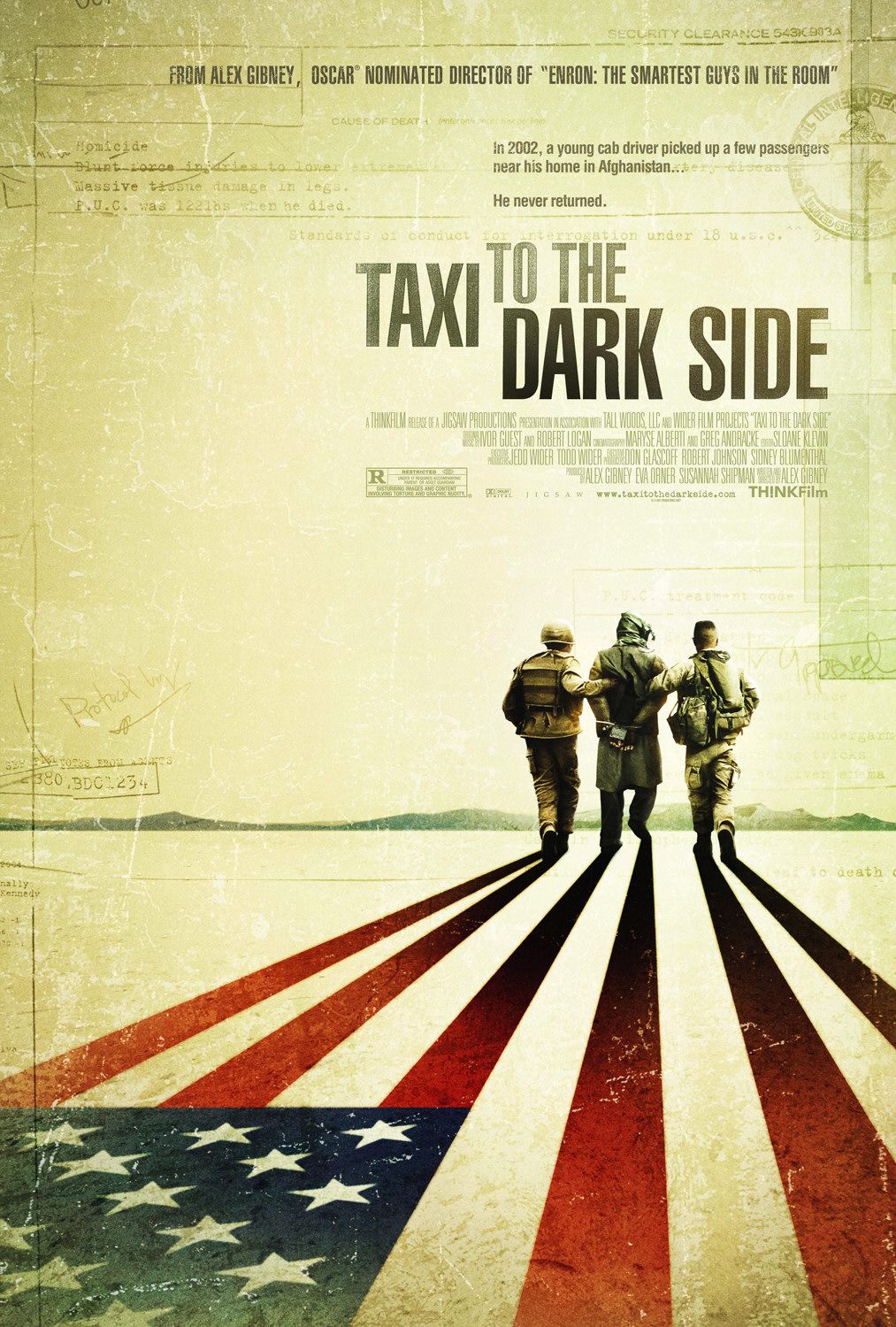
Taxi To The Dark Side

Taxi To The Dark Side is an Alex Gibney documentary film released in 2007 about the culture of torture in the US military, with the death of a young, innocent Afghan taxi driver - Dilawar - in a prison in Bagram as the launching pad. It critically examines the grassroots interpretation of that wildly ambiguous term, the 'War on Terror'. Actually Taxi To The Dark Side is considerably more nuanced than that inadequate description gives credence to. It doesn't just name and shame the minor players in various torture scandals but follows the rabbit hole all the way up to the highest echelons, continually questioning the humanity and morality of an administration and military that risibly looked to ignore or quash any suggestion of torture in American Afghani imprisonment camps. It examines Bagram then Abu Ghraib and then to Guanatanamo Bay, highlighting the vacuum of accountability.

In short, this is a very effective documentary. It's cleverly composed, using the Dilawar case as a rudder with which to steer every line of argument and includes refreshingly frank interviews with a multitude of different characters up and down the spectrum of responsibility. That includes the Military Police and Intelligence Officers who carried out the physical torture. Gibney alters the perception that an audience would have of them; he manages to convincingly portray them as victims of the system that allowed, encouraged even, the implementation of debilitating physical interrogation methods. It's difficult to feel genuine compassion for them (they were all convicted by military tribunals) but it suspends knee-jerk condemnation and contextualises their plight in a wider political atmosphere - an atmosphere that demanded intelligence about Osama bin Laden and al Qaeda at all costs. These were nice people who were morally isolated from the outside world, working in a culture that passively encouraged the dehumanising of its Muslim inmates in a manner not unlike the Nazi officers of Jewish concentration camps or the Einsatzgruppen

Of course the most controversial bits involve Dick Cheney, Donald Rumsfeld and General's McNeil and Miller and their apathetic attitudes towards the endemic contraventions of the Geneva Convention that occurred under their authority. Even more sickening though are the brutal 'interrogation' techniques and the documents signed by those movers and shakers that acquiesced to those methods. Stress positions, sexual humiliation, sleep and sensory deprivation are all described in vivid detail. Interspersed throughout are excerpts from G.W. Bush speeches - there's no doubt that it's a deliberate mechanism designed to shock, to evoke disgust and it bloody works.

Gibney's Taxi To The Dark Side is unpleasantly effective in its shocking portrayal of goes on in the supposedly civilised twenty-first century. It doesn't even end on a positive note - Guantanamo Bay is a continuation of the treatment prevalent in Abu Ghraib because it falls between the judicial cracks of Cuba and America, it's not at the behest of any national law. They can get away with anything they want. Depressing stuff. Not least because Taxi To The Dark Side received high exposure - it won a Best Documentary Oscar - and Gitmo continues to thrive despite vast worldwide outrage. Evidently there's no way of forcing closure through legal channels (Obama has twice promised and twice failed to ensure its termination).